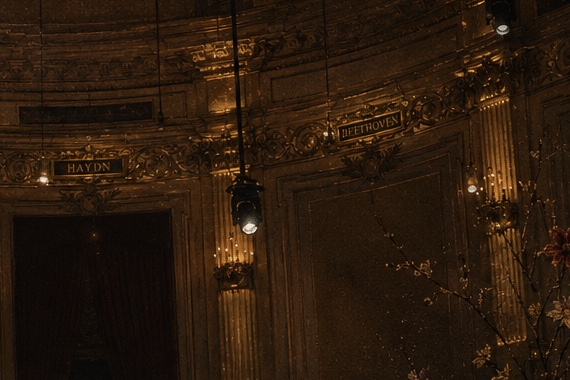
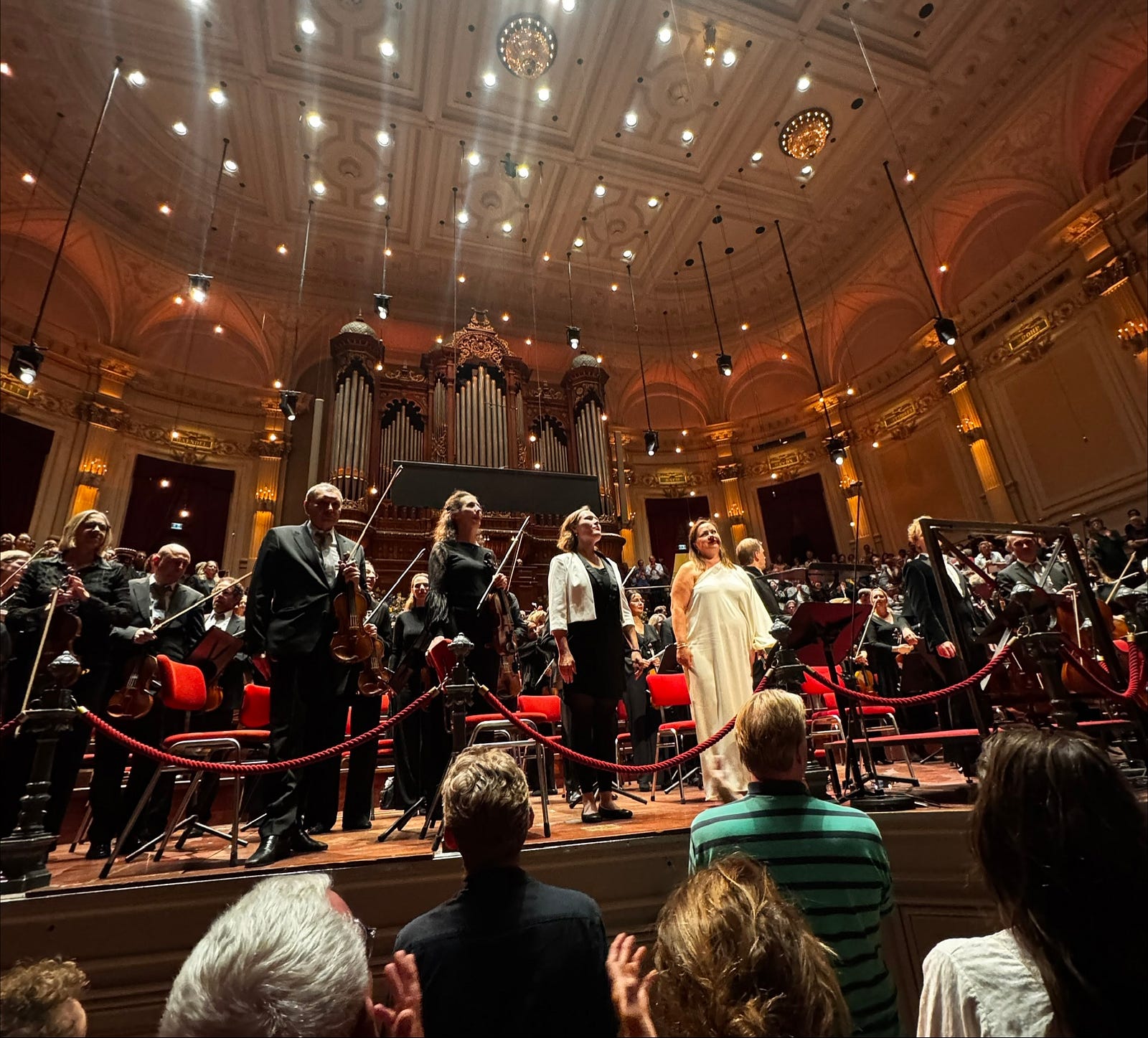
Recently, I returned to the Concertgebouw for two concerts. It has already been over a few weeks since those nights. One was a performance of Brahms’ A German Requiem with the Netherlands Radio Philharmonic Orchestra, the Groot Omroepkoor, and conductor Risto Joost; the other featured Ken Nagano and Mao Fujita performing Beethoven’s Piano Concerto №3. Whether viewed as summer concerts or regular season highlights, both were moving. What made them so deeply moving was a shared thread: a profound, palpable connection between the musicians and the composers.
Part I: A German Requiem — A Glitch in the Industry
Before this performance, I had never heard of Risto Joost. (I thought he was Dutch because of “Joost” but he was not)But sound is something you can always trust. I was anticipating the piece immensely. A few days before the concert, I found myself thinking: if the time ever comes for me to leave this dimension and I have a funeral, I want people to play Brahms’ A German Requiem for me. (Of course, if I leave behind enough money, hiring a rich-sounding orchestra and choir to perform it live would be even better.) I picture comfortable Thai latex pads covering the floor, draped in a quilt stitched together from beautiful fabrics I’ve collected my whole life. My family and friends would lie there beside me — though I would be the only one lying down by force. They could listen to the music and idly reflect on the moments we shared, whether sweet or otherwise.
This wasn’t a random whim; this work has brought me quiet peace on many sleepless nights. Now, days later, I still don’t know much about who Risto Joost is, but I feel I understand Brahms a little better. Joost was in no rush at all, echoing Brahms’ own slow, deep temperament. His conducting wasn’t technically flawless, but he allowed himself to feel completely within a loose, bounded control — a rare quality.
I truly love the voice of this soprano, Sofia Fomima. Many sopranos strive for a bright and smooth tone, but her voice has a special texture — not like thin silk, but like treated lace or gauze, bright yet grounded with earthiness. She is well-prepared, yet possesses a kind of spontaneity, truly like a sentimental bird perched high in the sky, resting on a tree.
Writing this makes me wonder if I should study the Requiem more rigorously. Yet, after four years of listening to classical music intensively, I feel the most daunting thing about the genre for an outsider is the constant sense that you never know enough. Perhaps all I can catch is whether a melody feels genuine and pleasant, but that is enough. This rendition felt like a massive, collective meditation. What I respected about Joost was how he, the choir, and the musicians simply dissolved into Brahms’ soul.
Concerts like this are exceptionally rare. It felt like a glitch in the capitalist matrix of classical music as a commercial industry. It was deeply moving, yet Joost wasn’t trying to make it moving; he simply wanted to present the work as it is.
There’s a quiet sadness in this realization. As a young person, buying cheap tickets, living close to a world-class hall, and possessing a receptive pair of ears is already an extraordinary luxury — not something readily available to everyone in this world. For me, even being there felt like a cosmic glitch. Knowing that some people in the audience might not truly listen, while many who could truly understand it may never have the chance to step into a concert hall, leaves me with a sense of regret about our world. But then, Brahms’ world was also filled with regret, and that regret gave birth to his music. We perceive it as beautiful, but it is a translation of complex, heavy emotions — regret, joy, and sorrow — that words can barely capture.
I am not a professional musician, but I deeply admire Risto Joost and the chorus master, Ines Kaun. This is a version of the Requiem I wish had been recorded. It moved like a solitary pilgrim on a long journey, advancing slowly and devoutly — or like Tibetan Buddhists performing full-body prostrations on the road to the Potala Palace. It demanded patience; there were no manufactured moments of cheap excitement, yet looking back at the end, it was breathtakingly beautiful.
Part II: Mao Fujita — Genius, Order, and Unspoken Tension
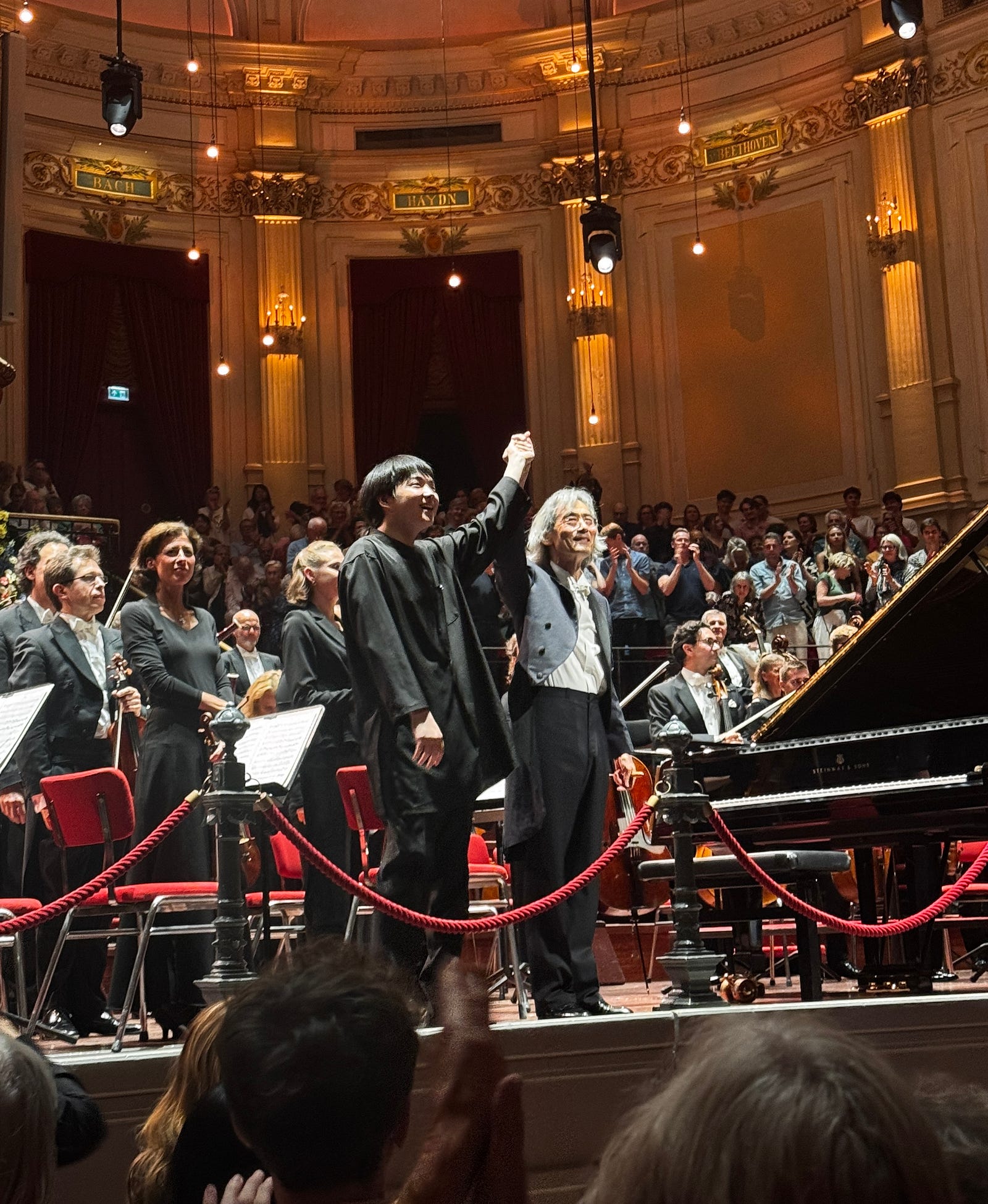
As for Mao Fujita’s concert, it brought to mind the order of the universe. The universe, it seems, sent Fujita into this world specifically to play the piano. I first heard him live in late 2024, when his Scriabin completely stunned me. This performance of Beethoven’s Third Piano Concerto allowed me to see him even more clearly. He is completely himself, yet holds absolute reverence for the music — a rare and marvelous combination.
In the piano world, some interpreters are fiercely individualistic, like Glenn Gould or Fazil Say; others honor history and the score while maintaining a distinctive personal touch, like Alfred Brendel or Evgeny Kissin. Fujita belongs to neither category. He plays like an objective third party — a historian recounting a story with pure, raw sincerity, guided by intuition rather than calculated intellect. A genius like that is hard to capture in words.
I once discussed the word “genius” with a young pianist, who argued that labeling people as such is unfair to their hard work. I’ve thought about it since, and I still consider Fujita a genius — not as mere praise, but in the sense that while everyone possesses innate gifts, he has spontaneously and relentlessly cultivated his, walking his path with complete devotion.
If I may offer an admittedly subjective observation on the prominent young East Asian pianists of today — Yunchan Lim, Bruce Liu, and Seong-Jin Cho, all of whom I’ve heard live in concert — their playing is undeniably exquisite, but almost too clean. So pristine that it feels polite and well-behaved.
That is where the contrast lies: Fujita appears to be the most “well-behaved” on the surface, but when he plays, he seems unconcerned with who he is or what he is doing. His performance is an act of pure contemplation, like an absorbed traditional storyteller. His genius isn’t just about having unique ideas; it’s that he dwells entirely inside the score with his own understanding. Because he holds the music in such high regard, he doesn’t care about being “behaved” in the real world versus “unbehaved” in his musical world, creating an extraordinary tension in his performance.
In an interview after the concert, Fujita mentioned that as he walked down the long red-carpeted staircase of the Concertgebouw onto the stage, it felt like entering a different realm where the magic begins. As he said this, his expression was completely innocent and gentle. I understand him — we navigate this strange world with a gentle, compliant exterior while carrying a heart that, by society’s standards, is quietly rebellious.
As I grow older, I constantly feel this pull: a capitalist-driven world pulling me toward cynicism and pragmatic thinking. If I were to measure music through that lens, I would write a very different review. But ever since an evening years ago when I took (magical) mushrooms and walked into the Concertgebouw, I swore to myself that I would always remain honest with music. Language carries baggage and ulterior motives, but music is just itself — I still cannot fully capture it in words — and within music, you cannot lie. You might fool an untrained ear with performative phrasing or overwhelming volume, but that deception is fragile. Music is the translation of an entire heart into the universe’s most primal vibrations. This is why I look forward so eagerly to Fujita’s future recordings and concerts; when a musician is supported by capital without being consumed by it, it feels like another system glitch in the universe.
Coda
I haven’t attended any concerts over the last weeks. Life has been busy with trivial yet necessary matters. But I accept that. Classical music, while operating as a complex commercial entity within capitalism, possesses an essence that transcends our daily dimension.
Sometimes I resent having such sensitive ears; a musician once told me my ears were too “spoiled.” Years ago, I might have been moved by every single concert I attended. Now, I pick up on the underlying motives — technically, emotionally, even spiritually. As a result, only a rare few performances can truly move me to my core.
Still, that is more than enough. The universe has no inherent good or bad, but at least I can choose the music I love.
 Serongtonin
Leave a comment