May 7, 2026. Het Concertgebouw, Amsterdam
In the environment I grew up in, I could never quite tell who was telling the truth. Sometimes people praised things with smiling faces; sometimes they wept with emotion. Only many years later did I realize that often they had to react that way, rather than being moved by some uncontrollable sincerity from within. Eventually, even they themselves could no longer tell whether they truly meant what they were saying.
Later, I moved somewhere else to live. Here, it seemed that nothing really needed to be glorified anymore. But last night, I realized that perhaps this kind of behavior is simply something humans inevitably produce whenever they live in groups — only the scale changes. From a nation of billions, to a musical institution.
Last night’s concert was Nathalie Stutzmann conducting the Royal Concertgebouw Orchestra in Johannes Brahms’ Fourth Symphony, with Augustin Hadelich performing Pyotr Ilyich Tchaikovsky’s Violin Concerto. I went for Hadelich. As one of the greatest living violinists of our time, he rarely disappoints an audience. The hall was completely full. I cannot say whether people came for Augustin, but if they came primarily for Stutzmann, I would be a little surprised.
This concert made me deeply uncomfortable. A very particular kind of discomfort.
The opening overture — Glinka’s Ruslan and Lyudmila — was still alright: energetic, festive, uplifting. When Augustin walked onto the stage, I was genuinely excited. But not long into the first movement, I realized something was wrong.
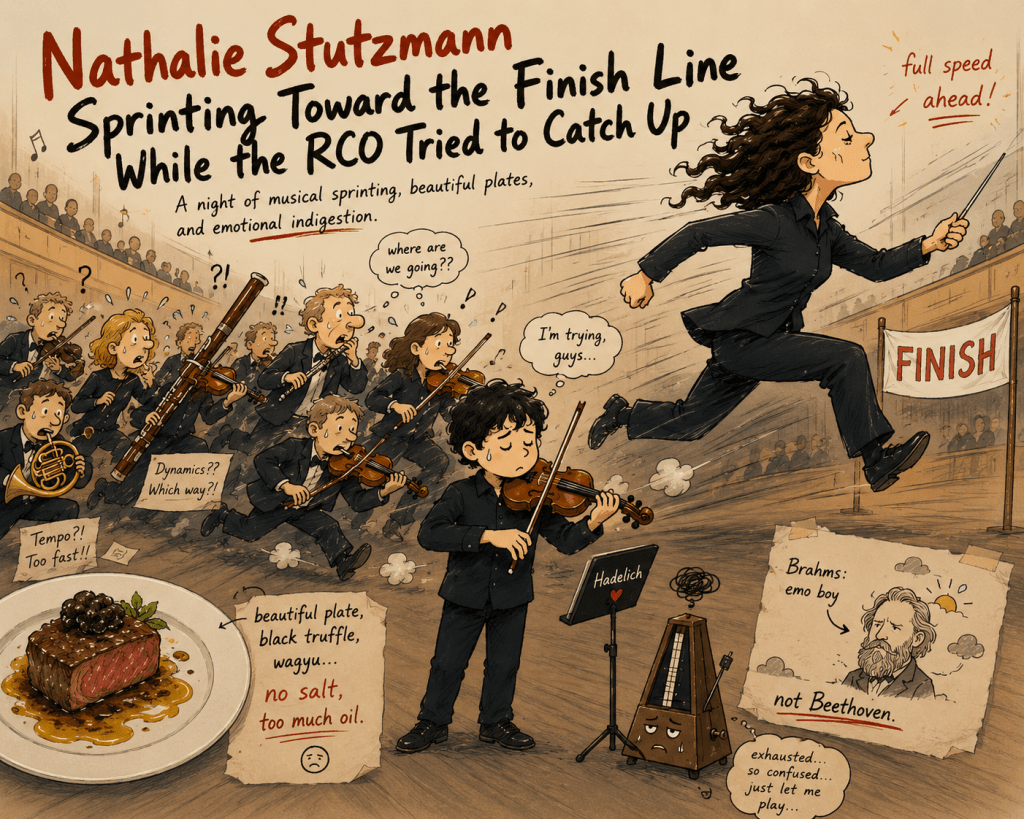
In a concerto lasting nearly forty minutes, Stutzmann seemed to begin a hundred-meter sprint. It felt as if she were the only person onstage.
Tchaikovsky’s Violin Concerto may not be as visually concrete as his ballets, but I have always felt his music possesses a strong narrative quality. Yet Stutzmann approached it like an overture, rushing forward at full speed. The orchestra had to scramble after her. Being the RCO, they were technically capable of accelerating without obvious cracks appearing. But the troubling thing was that even Augustin seemed forced to follow her.
In every performance of his I have heard, Hadelich has always felt astonishingly stable and precise — every note and phrase sharpened like a surgical knife. Yet last night, even he sounded slightly unsettled. After one whistle-like harmonic, there was a brief moment of wavering intonation. He had to follow Stutzmann, rather than the conductor supporting the soloist.
The triangle between conductor, orchestra, and soloist was completely falling apart.
But because both the orchestra and soloist were operating at such a high technical level, the audience could still feel that everything sounded “basically fine.” Tickets were expensive. Amsterdam is far away for many people. Many audience members were probably still immersed in the joy of hearing the RCO live, or hearing Hadelich in person. Perhaps I have simply listened to too much music and become spoiled.
To me, the sound felt like an extremely beautiful fine dining plate filled with wagyu beef and black truffle — visually astonishing — only for you to discover that the chef forgot salt and poured in too much oil. And somehow, after swallowing it, you are still expected to smile.
Another feeling Stutzmann gave me was that she seemed obsessed with performing dynamics.
Every work that survives through history already possesses its own inner soul. Inside that soul lives the composer’s emotional state at that particular moment in time. If a conductor truly brings that out, the dynamics emerge naturally, as though that moment itself has been recreated. Concerts like this can move audiences deeply, even if the orchestra is not technically the greatest in the world, because the story itself breathes.
But Stutzmann seemed not to understand this. She improvised her dynamics. She seemed to believe that heavy accents automatically create impact, or that suddenly making the orchestra quiet automatically creates emotion.
The RCO sounded like a gigantic confused instrument.
The musicians reminded me of office workers who no longer fully enjoy their jobs, but still try hard to present themselves as good employees. These improvised dynamics created a feeling of constant shock and interruption, confusing rather than moving. Writing this now almost makes me laugh. At least perhaps, in some strange way, we could feel the orchestra itself.
A good conductor can bring the musicians into the story as well. Then, while the orchestra functions as one enormous instrument, each musician also becomes a soloist. I do not think this idea originally came from me — I believe I once heard Iván Fischer say something similar.
Brahms’ Fourth Symphony is already one of his later works. I have always felt that Brahms was not an especially decisive person. He was not like Beethoven, defiantly struggling against fate, nor like Bruckner, hesitant yet utterly devout. Brahms feels to me like someone outwardly slow, hesitant, romantic — but with an inner core of loyalty and conviction hidden deeper beneath the surface.
Like a cloudy day: damp, grey, uncertain, but with sunlight quietly glowing behind the clouds the entire time.
In 2026, we would probably just call this “emo.”
I like to imagine Brahms as an emo boy who happened to compose masterpieces.
But Stutzmann conducted Brahms as though he were Beethoven. The firmness of her approach made me frown. It gave me stomach pain — the same kind of stomach pain as frying an excellent piece of wagyu beef in half a kilo of cheap french fry oil.
Her treatment of slow passages became extremely flat pianos, creating abrupt emotional dead ends. The problem is that Brahms is an intensely un-flat composer. Even when he becomes quiet, his thoughts continue multiplying endlessly. He is, after all, an emo boy.
After flattening everything for a while, she would suddenly begin sprinting through the marathon again, until she seemed exhausted and collapsed back into flatness. The beginnings and endings of movements — including the final ending itself — all felt strangely unprepared, almost like rough drafts. I was exhausted.
When the concert finally ended and the audience erupted into thunderous applause and a standing ovation, I felt physically and emotionally tired.
Honestly, two minutes into the first movement I already wanted to leave.
Perhaps this sounds melodramatic. Isn’t hearing the RCO supposed to be enjoyable no matter what? I thought so too. That is why I stayed. But her handling of the music gave me a genuine feeling of blasphemy. I became restless in my seat.
I want to clarify one thing. Sometimes we simply “dislike” a particular interpretation of music. But there are two different kinds of dislike.
The last time I heard the RCO perform Brahms 4 was with John Eliot Gardiner. That time, I was simply bored. My mind wandered constantly. But I never felt that Gardiner lacked structural control over the orchestra or failed technically as a conductor. We just did not emotionally connect. He can continue being himself.
Last night felt completely different.
With Stutzmann, the problem was technical. Her handling of the music felt suffocating. That is what made it so frustrating.
Today, I saw the RCO Instagram account post photographs from the concert, describing Stutzmann’s debut as “deep and precise.” Suddenly I felt transported back to those earlier years of my life — those smiling faces praising things, unable to tell whether they truly meant it themselves. Underneath the post were more glowing comments about the concert.
For some reason, this kind of PR language suddenly felt almost funny to me.
Classical music remains such a prestigious world. How many people can travel to Amsterdam? How many people have heard Brahms? How many can afford concert tickets?
When I first accidentally wandered into concert halls years ago, I found this world incredibly warm and welcoming, especially for someone like me — a foreigner with no formal musical background. Because of that openness, I was able to continue listening over these past four years. I still feel grateful for it.
But last night I suddenly became aware of the other side of that openness.
As Laozi wrote:
“Being and non-being give rise to each other.
Difficult and easy complete each other.
Long and short define each other.
High and low depend on each other.
Sound and voice harmonize with each other.
Before and after follow each other.”
This other side is not evil. It has always existed. Last night, I simply saw it more clearly.
Still, there is one thing I remain genuinely curious about: how was Stutzmann invited?
If the management of the RCO all possess musical backgrounds, then surely at least some people must understand her level. I previously heard Stutzmann conduct the Netherlands Philharmonic with Daniel Lozakovich in Mendelssohn’s Violin Concerto, and that performance also made me feel physically uncomfortable. At the time I assumed it was simply an unfortunate evening. Perhaps it was not.
Where I grew up, speaking too honestly could sometimes make it difficult to continue your life afterwards. Tonight I said many honest things, including repeated references to stomach pain. I still hope I can continue listening to the RCO and continue going to the Concertgebouw. They remain among the most beautiful things in my life.
But precisely because I love them so much, I cannot lie about sound or listening.
So I wrote this.


Leave a Reply