A Listener’s Note on Competitions in the Classical Music World
Between Curation and Conviction
Manipulation can happen in any kind of relationship — including the one between musician and audience — when a musician knows exactly how to make something sound good. That gave me the bad kind of goosebumps. The “ew” kind.
Last month, I went to a piano recital. I remember really liking the performance that night — the pianist was technically brilliant, immediately impressive. The kind of playing that makes you sit up straight. He’s tall, handsome, polite. Everything fits. It’s rare. I instantly felt: he’ll probably become a star.
And I wasn’t wrong. This morning, I woke up and saw he had just won the Queen Elisabeth Competition — one of the most prestigious in the world. From now on, he probably won’t need help selling tickets.
But here’s the thing: I kept listening after the concert. And the more I listened, the less I could continue. His playing started to give me a strange feeling — not because it lacked control, but because it had too much of it, while pretending spontaneity. Every note seemed to whisper:
“I know this sounds beautiful.”
“I know this will come across as thoughtful.”
“I know what the audience and the jury want to hear.”
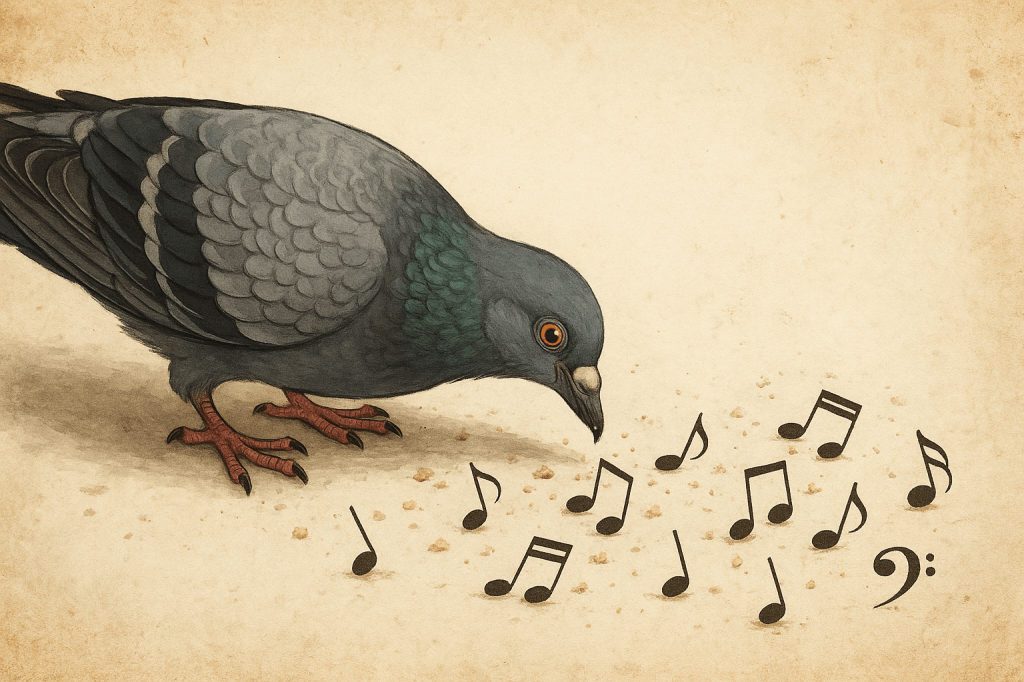
That’s when I realized — I don’t believe in competition. I don’t believe in rankings, or in the idea that one interpretation is “better” than another. The whole system is a performance in itself — a trick of capital, scattering breadcrumbs to pigeons. It rewards spectacle, strategy, and the polished kind of “sincerity,” all dressed up in social media aesthetics. But rarely: truth.
It reminded me of another concert — Mahler’s Fourth Symphony in Berlin, conducted by someone with a reputation for aesthetic extremity. It was a real matsutake-style move: I didn’t even buy a ticket, just waited at intermission, and an older man handed me his. The concert was loud, glittering, smooth, and emotionally hollow. It didn’t give me space to think — only to be impressed. And then came the thunderous applause.
As an audience, you are only allowed to applaud (or not). To say “bravo” or “boo.” You are simplified into a pigeon, cooing on cue.
That’s what some competition-winning performances have begun to feel like: they offer all the right gestures of emotional depth, without taking the risk of actually feeling. And maybe in 2025, that’s what most audiences prefer — something that sounds profound but doesn’t ask too much. Immediate beauty. Quick impact. Applause-ready. Capital’s favorite.
But that kind of music becomes interchangeable. It smooths out the edges between composers. It becomes background poetry. Aesthetic caffeine. It leaves no room for silence, for confusion, for being wrong — all the things that make music alive.
And music doesn’t have to be beautiful. But it must be true.
In competitions, fellow humans are elevated into the role of judges. They may be more experienced, sure — better at playing the instrument than you or I — but that doesn’t make them the oracle of what deserves to be ranked 1–2–3.
I believe in my ear, when it can still hear.
I don’t believe in this system. I believe in resonance.
Competitions are not sacred.
They are not divine truth.
They are not scripture.
They are not the Bible.
They’re just one way the machine keeps running.
But real music? That’s like mushrooms and mosses — it lives outside the machine.
I dream of a nuance-based world.
P.S. If you want to listen to something else — something that doesn’t sparkle for effect or try to impress — I recommend Sergey Tanin, another finalist. He has a Schumann album I’ve been listening to just to soothe myself down. Somehow he sounds like a future master. Not a piano star, but a planet that stays and nourishes the beings.


Leave a Reply