
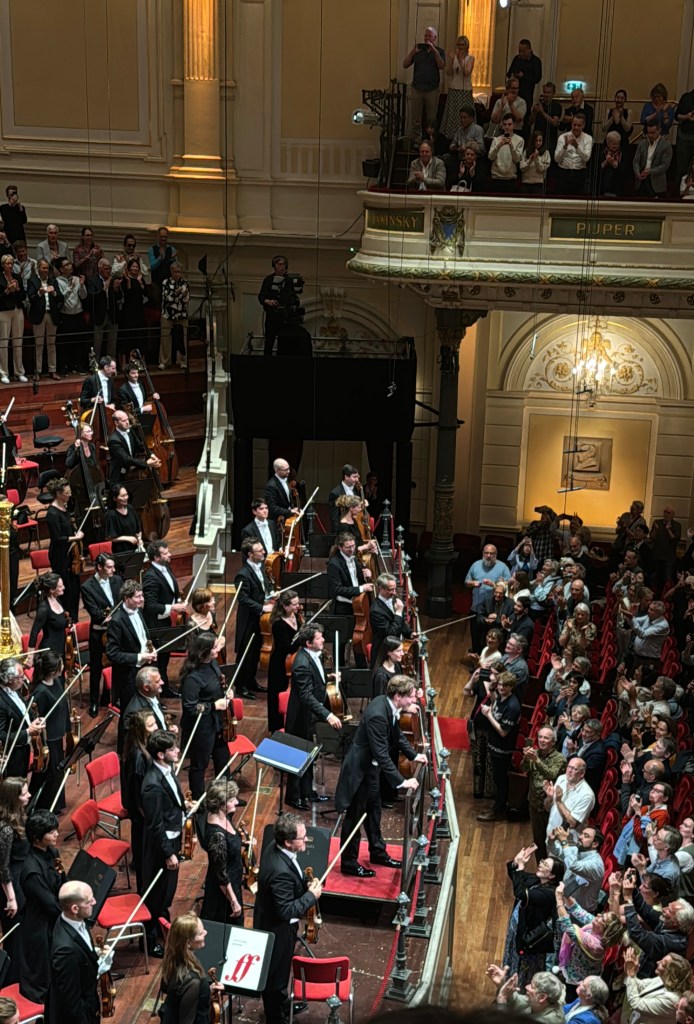
On the first night of Mahlerfeest 2025, we sat in a charged stillness. The air in Het Concertgebouw trembled before the warm welcome by Simon Reinink and the first note under the baton of the Klaus Mäkelä. It begins quietly, yes, but not gently. A stirring. A waiting. Spring doesn’t announce itself with sound; it arrives through tension. And then, like a sudden thunderclap: Mahler’s world begins.
The first movement, subtitled “The Days of Youth, Flowers, and Thorns,” emerges with patience. Klaus Mäkelä doesn’t rush. The music unfurls like a tree in March—not eager to bloom, but listening for the one bird call it’s waiting for. A rainbow-colored cloud floats above the strings as long-held notes stretch across seven octaves. Then the cuckoo enters—clarinet-spoken and precise—joined by distant trumpet fanfares like birds calling across mountains.
There is a phrase in Chinese: 如履薄冰—”as if treading on thin ice.” Mahler’s beauty often evokes this sensation. Yet in Mahler’s world, the ice doesn’t break. It welcomes you, surrounds you, but never lets you fully grasp it. There is no violence in its distance, only radiant untouchability. As if our senses—five, ten, or more—are not quite enough to perceive what’s truly there.
The second movement, a Scherzo rooted in Ländler rhythm, found its heartbeat in Mäkelä’s steady hands. There’s a scene here: trees dancing under starlight while humans sleep. The RCO strings—often described as velvet—gain weight and depth from the firm entrance of the cellos. It’s a new texture: still lush, but now grounded. Like velvet backed with oak.
The third movement is a dark smile. The solo double bass walks forward like the footfall of a mythical creature. Mäkelä draws out the grotesque humor: a hunter’s funeral, painted with Klezmer, children’s tunes, and twisted village-band echoes. RCO’s texture glimmers here—not as individual instruments, but as one unnamed organism, breathing. As Théotime Voisin, the double bass principal of tonight, later shared in a post-concert interview: every bassist knows this solo will come for them someday. It did. Mäkelä shook his hand first.
The Finale, titled in its earlier version as “Dall’ Inferno al Paradiso,” begins with a cry—a wound in sound. Then comes the great Mahlerian gesture: beauty, unashamed, rising. Mäkelä’s interpretation of the lyrical themes avoids sentimental excess. Instead, they land with sincerity and breath. The music becomes less about prettiness, more about heartbeat.
Mahler’s Symphony No. 1 premiered in 1889, in Budapest, to an audience that didn’t know what to make of it. The shifts in mood, the irony, the lack of formal ‘obedience’—it was unsettling. It still is. And yet, for some of us—for the neurodivergent, the wanderers, the romantics, the grief-witnesses—it feels like coming home. These transitions aren’t chaos; they are *life*.
Klaus Mäkelä, at 29, brought detail without rigidity. He didn’t present Mahler as something sacred or antique. He presented him as someone alive. For a second, it felt like 29-year-old Klaus looked straight across the time-void into 29-year-old Gustav Mahler, and neither blinked.
At the midnight talk following the concert, Marina Mahler—Gustav’s granddaughter—spoke of her grandfather not as a maestro, but as a boy who lost siblings, who read Dostoevsky, who carried a wound into music. She shared how a child once told her he didn’t need therapy because he had Mahler’s Third. And in that moment, in 2025, with a world still not at peace, her words felt more contemporary than any press release.
Perhaps that’s what Mahler offers—not a rebellion against old forms, but a creation of a new cosmos. One that still, even now, feels new.
 Serongtonin
Leave a comment