
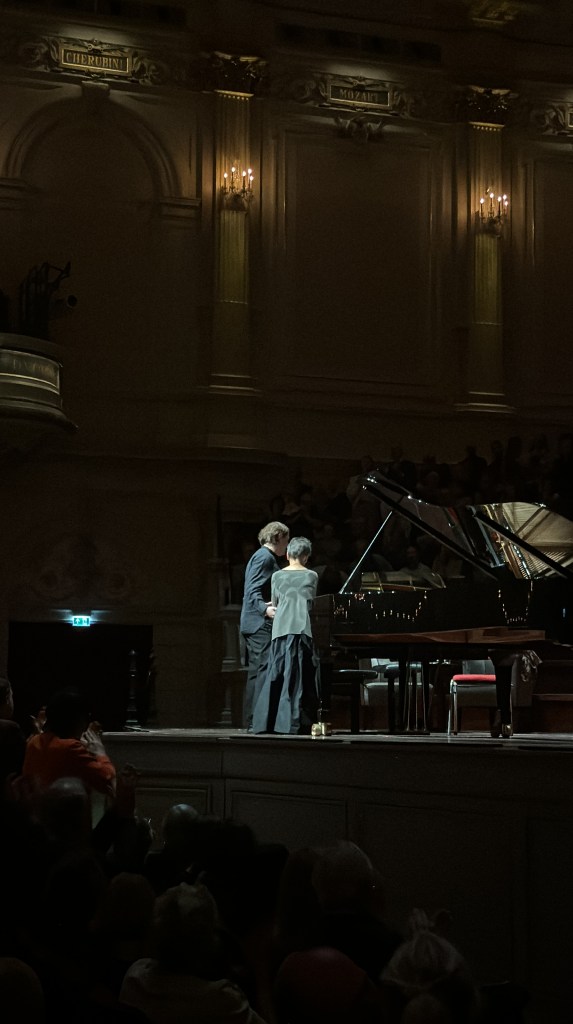
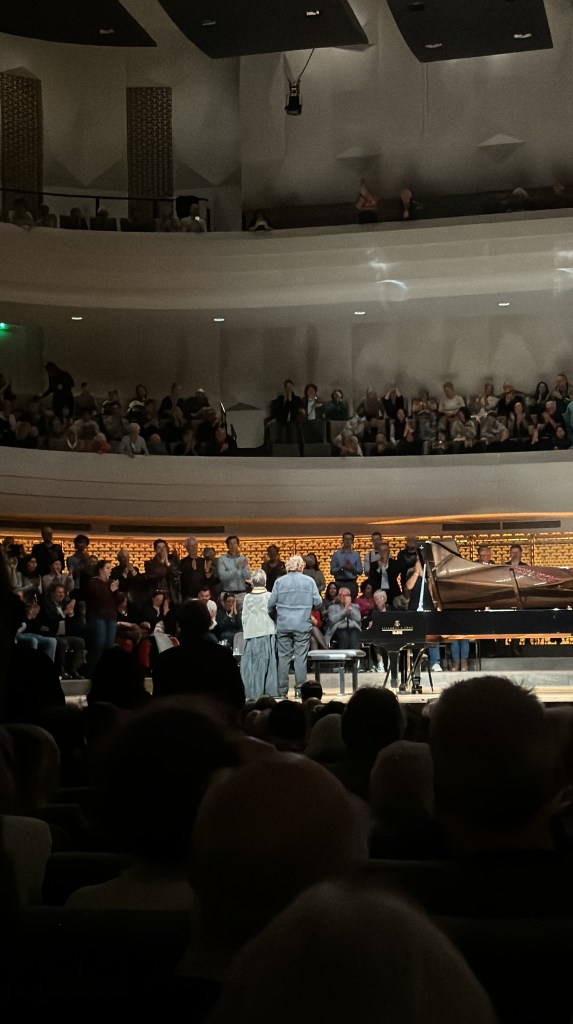
Concerts: March 16, Het Concertgebouw (Amsterdam) & March 19, Amare (The Hague)
Artists: Maria João Pires & Ignasi Cambra
Programme: Mozart K.594, Haydn Sonatas in C major & E-flat major, Schubert Impromptus, Drei Klavierstücke, Lebensstürme
Reviewed by Rong & Aurorian
Concert experiences can be supernatural — last week, I learned that for the first time.
At some point, I had to close my eyes: the music kept flowing, but time froze, like a black hole filled with color. Like a lucid dream, but real — in a concert hall both sincere and ornate. I knew the music had ended, I heard the applause, but it felt like the door had closed on me in another realm.
I love Pires — yes. And I didn’t know Cambra, to be honest. But I find it sweet that she brought him along as an equal duo. I don’t know the full story, but it feels like a gift.
When Pires plays, you just want to follow her through the tour. She’s sacred and precious — musically, energetically.
Mozart K.594 – A Clock in the Mausoleum
This piece was originally written for a mechanical organ, to be played in a mausoleum. It belongs to one of Mozart’s least “Mozart-like” corners — ritualistic, structured, and deeply solemn. There’s weight in it — a sense of the eternal — and still, somehow, the flicker of that splendid Mozartian joy.
Pires and Cambra leaned into its Romantic potential. Rubato was abundant, and while their phrasing breathed with sincerity, it softened the structure’s inner scaffolding. Mozart the human was there — but Mozart the cosmic architect, the one writing for a tomb’s ticking clock, was harder to find.
Eschenbach and Justus Frantz recorded this piece with such tight, inevitable phrasing that it felt like time itself marching forward — not expressive, but immense. In contrast, Pires and Cambra gave us something warmer, more affectionate than eternal.
But their direction was clear. It wasn’t an accident. It was a choice. And that kind of clarity always deserves a hearing.
Haydn – Cambra: Sonata in C Major, Hob. XVI:20
Haydn’s piano sonatas are often overshadowed by Mozart’s elegance and Beethoven’s depth, but they hold their own brilliance — wit, invention, and crystalline form. This early sonata from 1771 has the cheerfulness of youth and the influence of Scarlatti and C.P.E. Bach, with folk-like themes twisted into elegance.
Cambra began with near-weightless grace — every note perfectly placed: The opening rang like a wind chime, and when the ascending scale came, it felt like a rainbow arcing across the sky — sudden, luminous, ephemeral. If this were wine, it would be a crisp white, mineral and clear, breathing beside a mountain stream.
His tempo moved fast, but never rushed — like breathing through an unblocked nose on a spring morning. Even the transitional passages felt like a mountain’s silhouette: curving, patient, inevitable. It was lyrical, light, but grounded — like walking on different textures (mud, stone, sand) with natural balance. You could feel it in the phrasing: not equal, but instinctive. Like a dance born from walking. Some articulation blurred, like slurred watercolors — but the structure never collapsed. The lines flew.
It felt like stream-of-consciousness through time, with a curious, youthful soul — not trying to impress, just gently stimulating every nerve. Cambra doesn’t seem to learn music from paper. He learns it from breath.
Haydn – Pires: Sonata in E-flat Major, Hob. XVI:52
Written in London in 1794, this was Haydn’s last and grandest piano sonata. It carries drama, boldness, and orchestral texture — a pre-Beethovenian storm, written by someone who had lived a full musical life. It’s like walking through a house you built, opening all the windows one last time.
Nothing under Pires’ hands sounded harsh. Even the boldest chords resonated not with force, but with presence.
In the Allegro, the notes leapt like a wise child — someone who knows everything, but still chooses joy. Her contrasts weren’t obvious. She defies binaries: light yet grounded, free yet disciplined. Her phrasing lives in her blood. Closing my eyes, it felt like she was sculpting light.
The Adagio opened with space and patience. The rubato never felt planned — it moved like a memory. She played like someone with all the time in the world, and no one to owe it to.
In the Finale, she danced — not to dazzle, but to speak. Her touch was velvet around every note.
Some might prefer a stricter Haydn — leaner, sharper. But Pires lives the music. And when someone plays like that, rules bow.
A Few Words That Aren’t Enough: On Pires & Schubert
Who am I to comment? This isn’t interpretation. It’s transmission.
When Pires plays Schubert, it feels like he lived long enough to speak through her — older, softer, still alive. It’s not “playing.” It’s a flow — like water in all its forms: stream, river, ocean, mist. Water that vanishes, but makes flowers grow. Invisible, but nourishing the sky.
I felt this especially in the Andante from D.664. The form is simple, A–B–A — like life: uneven, rich, but never loud. In the B section, there’s something like a silent firework — a moment you remember forever, but never speak about.
Then it returns to calm, as naturally as it came. Nothing is exaggerated. Everything is sincere. No announcement. Just: Schubert, still alive, through her.
Cambra: Klavierstücke & the Lively Stream
When Cambra plays Schubert — especially D.946 No.3 — you feel it instantly: he’s the younger one. Not less capable, but his pulse is different. You can hear the heart beating faster.
If Pires is timeless water — clouds, rivers, the sea — Cambra is the stream itself. Cheerful, energetic, bursting over stones. His notes are clearer, defined more by touch than phrasing. He has gravity too, but of another kind. He’s a planet you’ve never visited. The rain is different. The sun glows in phosphorescence. Time bends.
His phrasing is kaleidoscopic — shifting, vibrant, complex. If Pires is memory, Cambra is discovery. One carries the wisdom of life lived, the other, the curiosity of life unfolding.
Lebensstürme — Storms in Legato
As a duo, Pires and Cambra spark quietly. But in this performance of Lebensstürme, their constellation blinked more than it burned. The piece, dramatic in name and structure, was wrapped in so much legato that some emotional weight dissolved into mist. That had its own beauty — like listening in a stone church. The sound expands, echoes, but loses some clarity. The notes flowed, yes, but not always with momentum. It was full, warm — but also slightly tiring.
Compared to versions like Eschenbach’s — lighter, more architectural — this one felt inward, atmospheric. Perhaps it was a gentle storm, not a tempest. Still lovely. Still sincere. They chose softness over drama — and that’s a kind of bravery too.
Some Final Notes
Pires, with her bright eyes and soft tone, gave Cambra space to shine, while anchoring the performance. She wasn’t just playing with him — she was elevating him. Guiding, but never overshadowing. And of course, giving him the platform of her name.
If she cared only for herself, she could’ve toured solo and sold out any hall. But she chose this duo. That means trust. That means belief, joy, and hope. She sees today. And she sees the future. And Cambra is part of that.
At Amare, I had a brief moment to speak to her. I don’t know if I was too bold — my autism couldn’t help — but I told her,
Time froze. And I don’t think you’re older or greater. You’re just carrying the truth, like the universe itself.
She smiled and said,
“That’s an interesting thought. And I get what you mean. I think you’re right.”
Later I watched a recent interview. She said, in that soft, steady voice,
“You should take all the risks… to open up.”
I opened up — to her music, to Cambra, to what they carried.
And it was the most reciprocal thing I’ve ever felt.
 Serongtonin
Leave a comment