
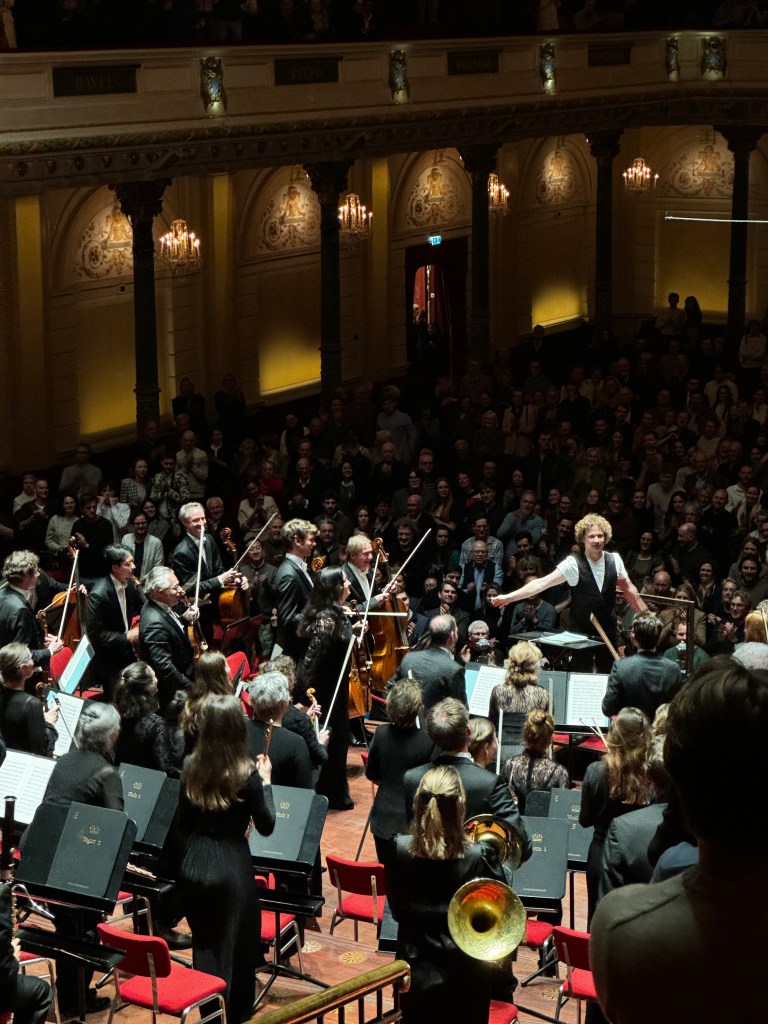
Last Saturday, Concertgebouworkest Essentials, featuring a short interview before the music:
When Santtu-Matias Rouvali described the final chords of Sibelius’ Fifth Symphony as ‘shooting the swans with a gun,’ I wasn’t sure whether to laugh or worry.
Sibelius’ Fifth Symphony is an enigma — a work that breathes, expands, and contracts like a living entity, capturing the vast Nordic landscapes, the shimmer of light on frozen lakes, and the grandeur of swans in flight. Some performances elevate it into a vast, unfolding vision of nature; others rush forward, clipping its wings before it ever fully takes off.
Last night at the Concertgebouw, Santtu-Matias Rouvali led the Royal Concertgebouw Orchestra in a performance that had moments of sheer beauty but at times felt like it was chasing its own breath. While RCO’s velvet-toned strings provided a warm foundation, the interpretation as a whole left me longing for a greater sense of space, inevitability, and organic development.
First Movement: A Symphony in a Hurry
The opening sunrise-like tremolo in the strings was there, yet instead of gradually blooming into existence, the orchestra leaped too quickly into a full forte, leaving the build-up feeling rushed. Sibelius constructs his phrases like archways — each one needing time to settle before giving way to the next. Here, the pacing often felt unsteady, as if the transitions weren’t breathing naturally but jumping ahead.
The famous horn calls (La-Re-Mi-La, Sol-Do-Re-Sol) — symbolizing the swans in flight — sounded beautiful in tone, but they were pressed forward instead of floating above the texture. The strings, which in Sibelius function almost as brushstrokes on a vast landscape, felt detached from the brass at times. There was motion, but not always the sense of deep-rooted inevitability that makes this symphony so powerful.
By the climax, the tempo had accelerated to a point of instability, and rather than a majestic surge, it felt like the orchestra was scrambling to catch up. The final chords of the movement came not as an arrival, but as an abrupt landing.
Second Movement: A Dream-Like Lyrical Contrast
Here, things settled. The woodwinds wove an enchanting tapestry — lyrical and spacious, like a slow walk through a sunlit Nordic forest. The interaction between the clarinet and strings in the opening theme was particularly delicate, and the RCO’s legendary string sound finally had room to breathe.
One of the most beautiful moments came when the violins took over the main theme (Re-Do-La-Si-La…), their sound glowing with warmth. Goosebumps. This was the kind of phrasing I had been waiting for — lyrical, inevitable, and unforced.
Yet, in some of the staccato pizzicato sections, the tempo felt strangely deliberate rather than buoyant, making the rhythmic pulse sag slightly. The movement’s ending, too, felt cut short, lacking the sense of gentle fading that can make it feel like mist dissolving into air.
Third Movement: A Swarm of Bees, Not a Flight of Swans?
This was where Rouvali’s fast-paced, high-energy conducting style was most apparent. The opening gallop was so quick it felt like a runaway train — thrilling, yes, but was it still Sibelius? The brass chorales that should soar with grandeur instead felt clipped, as if they had to rush to keep up with the runaway strings.
One particularly creative touch: Rouvali added percussive effects with the double basses striking their strings with the bow, creating a fluttering sound reminiscent of wings flapping — a fascinating detail that played into the work’s natural imagery.
However, what should feel like a powerful ascent toward the heavens still lacked a firm foundation. The breathless pacing made the orchestral swells feel ungrounded, and the final six monumental chords — which should land like the footsteps of a giant — lacked decisiveness. Some audience members clapped prematurely, as if unsure whether the symphony had actually ended.
Final Thoughts: A Performance That Flew, But Never Soared
Santtu-Matias Rouvali and the RCO delivered a Sibelius 5 that was full of energy, rich in texture, and undeniably well-played. There were moments of breathtaking beauty, particularly in the second movement, where the strings and woodwinds found a natural flow. But the overall interpretation lacked the gravitational pull, the breathing space, and the profound inevitability that makes this symphony feel like a force of nature.
Sibelius once described watching a group of sixteen swans take flight, which directly inspired the symphony’s final theme. Yet last night, instead of swans gliding through a vast, open sky, it often felt like a swarm of bees buzzing in tight formation — fast, precise, but missing that expansive sense of the Nordic sky stretching infinitely overhead.
For a Sibelius 5 that truly breathes, perhaps one must turn to Celibidache’s slow-burning, hypnotic interpretation or the deeply considered phrasing of conductors like Paavo Berglund or Osmo Vänskä. Still, Rouvali’s approach had charm, risk-taking, and an undeniable sense of forward momentum — even if, at times, it left me gasping for air.
For a Sibelius 5 that breathes with space and grandeur, Celibidache’s recording with the Munich Philharmonic offers a strikingly different perspective.
(Also, I loved how Sibelius write about swans in his diary… doesn’t feel like he wanted to shoot them. “Today at ten to eleven, I saw sixteen swans. One of the greatest experiences of my life! Lord God, what beauty! They circled over me for a long time. Disappeared into the sun like a gleaming silver ribbon… their cry the same woodwind type as cranes but without tremolo. The swan hymn. Nature mysticism and life’s angst!”)
 Serongtonin
Leave a comment